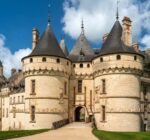


The towers of Inveraray Castle appear without warning. You’re driving through Argyll, the loch glittering to one side, and then there they are — four grey-green turrets rising behind a sweep of lawn as if someone planted a fairytale and let it grow. This is one of Scotland’s most recognisable castles. And yet most visitors to Scotland never make the detour to see it.
That’s their loss.
A castle built to impress
The castle you see today was not built in the Middle Ages. The 3rd Duke of Argyll commissioned it in the 1740s — not to defend a hilltop, but to announce his family’s place in the world.
Architect Roger Morris designed the main structure. The result was one of Britain’s earliest examples of Gothic Revival architecture: a castle that looked ancient and romantic while being thoroughly modern. Four conical turrets frame a square central tower. The whole structure sits on a small rise above the River Aray, just where it meets Loch Fyne.
Construction began in 1746 and took decades to complete. Robert Mylne was brought in later to design the interiors, and he gave the rooms an elegance that matched the castle’s dramatic exterior. The effect is a building that feels simultaneously grand and liveable — which was, of course, entirely the point.
The Campbells — Scotland’s most powerful clan
Inveraray Castle has been home to the Dukes of Argyll — chiefs of Clan Campbell — for nearly three centuries. Before the current building, an earlier fortification stood on the same ground for centuries before that.
The Campbells were, at various points in Scottish history, the most powerful family in the country. They accumulated land, titles, and political influence in a way few other clans could match. That power is still visible here, in the sheer scale of the castle and the estate surrounding it. This was never just a home. It was a statement.
Today, the current Duke of Argyll still uses part of the castle as a private residence. The family has opened it to visitors each year, making Inveraray one of Scotland’s most enduring occupied historic homes.
The armoury hall that stops you mid-step
Walk into the entrance hall and you will stop walking. The walls and ceiling are covered, floor to ceiling, with weapons. Muskets, swords, axes, and pistols are arranged in intricate geometric patterns — more than 1,000 pieces in total.
It is not just the quantity that stuns you. It is the deliberateness of the arrangement. These weapons were not stored here — they were displayed here, like art. Many date from the 1700s and saw actual conflict. Others belonged to generations of Campbell clan members who served in various campaigns across Britain and beyond.
The rest of the castle keeps pace. The state rooms hold original 18th-century furnishings, portraits, and tapestries. The drawing room ceiling is painted in the French style. The dining room has barely changed in 200 years. Everywhere you look, there is something that was placed here with intention — and has stayed.
Love exploring the world? Join thousands of travellers who get stories like this every week. Subscribe free →
The day Downton came to Argyll
In 2012, the cast and crew of Downton Abbey arrived at Inveraray Castle. The production needed a Scottish Highland seat for its Christmas special — the episode where the Crawley family travels north for a shooting party hosted by a Scottish earl.
Inveraray became the fictional Duneagle Castle. Its entrance hall, its grounds, and its corridors all appeared on screen. Millions of viewers watched, unknowingly, as real Campbell family history played as backdrop to the fictional Crawley drama. The armoury hall you can walk through today is the same one that appeared in those scenes.
It is the kind of detail that gives a visit an extra layer. You are not just looking at a building — you are standing in a place where history has multiple meanings, and where the line between real and imagined has always been a little pleasantly blurred.
Plan your visit to Inveraray
The castle opens to visitors from spring through to autumn, typically April to October. It sits in the village of Inveraray itself, on the western shore of Loch Fyne in Argyll — about 60 miles north-west of Glasgow along the A83.
The grounds alone justify the journey. The formal gardens include a restored Victorian kitchen garden with roses and herbaceous borders. Woodland walks spread out beyond the lawns, with views over the loch and the hills beyond.
While you are in Inveraray, Inveraray Jail is an excellent pairing — a 19th-century prison that gives a vivid and occasionally uncomfortable picture of Scottish justice. It sounds grimmer than it is; in practice, it is one of the most engaging heritage experiences in the country.
If Inveraray has whetted your appetite for Scottish castles, Scotland has no shortage to offer. Craigievar Castle in Aberdeenshire is a fairytale in pink stone. Dunnottar Castle, perched on a sea cliff, hid the Scottish crown jewels from Cromwell himself. Scotland rewards those who stray from the well-worn path.
Frequently asked questions
Can you visit Inveraray Castle?
Yes. Inveraray Castle opens to visitors from April to October each year. Tickets cover the state rooms, the armoury hall, and the gardens. Check current opening times directly with the castle before visiting, as hours can vary by season.
Does anyone live in Inveraray Castle today?
Yes. The Duke of Argyll — chief of Clan Campbell — uses part of the castle as a private residence. The family has lived at Inveraray since the castle was built in the 18th century, making it one of Scotland’s longest-inhabited ancestral homes.
What was Inveraray Castle used for in Downton Abbey?
Inveraray Castle served as the fictional Duneagle Castle in the Downton Abbey Christmas special, broadcast in 2012. Several scenes — including those set in the armoury hall and the grounds — were filmed on location at the real castle in Argyll.
For Those Who Dream In Miles
Every week, get travel stories that take you somewhere extraordinary — castles, coastlines, hidden villages, and the roads less travelled.
Love more? Join 64,000 Ireland lovers → · Join 43,000 Scotland lovers →
Free forever · One email per week · Unsubscribe anytime
Inveraray Castle is not a ruin. It is not a heritage attraction that happens to have a noble past. It is a living place — one that has belonged to the same family for nearly 300 years, that opened its doors to a television crew when they came asking, and that still watches over Loch Fyne from its four grey towers. Some things endure because they deserve to.