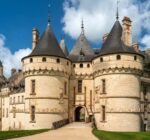


Stand on the western bank of the Nogat river on an early morning in October, and Malbork Castle emerges from the mist like a city unto itself. Three concentric rings of burnt-red brick walls climb back from the water, each tier taller and more forbidding than the last, until the eye reaches the High Castle—a fortress within a fortress, crowned by a single square tower that once watched over the largest territorial state in medieval Europe. This is not a single keep perched on a crag. Malbork sprawls across 21 hectares, making it the largest brick castle in the world and the medieval headquarters of the Teutonic Order, the crusading military brotherhood that ruled much of the Baltic coast for two centuries.
A Fortress Built by Holy Warriors
The Teutonic Knights broke ground on Malbork—then called Marienburg, “Mary’s Castle”—in 1274, after decades of conquest in what would become Prussia. They needed an administrative heart for their growing theocratic state, and they chose a strategic bend in the Nogat, a distributary of the Vistula, where river traffic could be monitored and taxed. The High Castle came first: dormitories, chapels, refectories and armouries arranged around a central courtyard, all built from millions of handmade bricks fired in kilns along the riverbank. When the Order’s Grand Master relocated here from Venice in 1309, Malbork became the capital of a domain stretching from Pomerania to Estonia.
The Middle Castle, added in the early 14th century, housed the Grand Master’s palace—a suite of vaulted halls warmed by hypocaust heating and lit by tall Gothic windows. The palace’s Summer Refectory, with its slender granite columns branching into fan vaults, remains one of the most elegant spaces in medieval military architecture. By 1350, the castle complex had grown to include a third defensive ring, the Lower Castle, enclosing workshops, stables, and the massive St. Lawrence’s Church. At its peak, Malbork was home to some 3,000 knights, monks, servants, and craftsmen—a self-sufficient fortress-city that doubled as a symbol of Christian dominion over the pagan Baltic.

Decline, Destruction, and Meticulous Rebuilding
The Teutonic Order’s supremacy ended in 1457, when a confederation of Prussian nobles and towns, weary of taxation and autocratic rule, sold Malbork to the Polish crown. The castle became a royal residence, then a garrison, and by the 18th century—after Prussia reclaimed the region—a granary and barracks. Much of the High Castle’s interior was gutted to store grain. Romantic nationalists in the 19th century, seeing Malbork as a symbol of medieval German might, launched an ambitious restoration under architect Conrad Steinbrecht, who spent four decades rebuilding chapels, halls, and towers from archival drawings and archaeological fragments.
The Second World War nearly undid that work. In early 1945, as Soviet forces advanced into East Prussia, Malbork became a fortress once again. German troops turned the castle into a strongpoint; the Red Army responded with artillery. By the time the fighting ended, roughly half the complex lay in ruins—roofs collapsed, vaults shattered, the High Castle’s chapel tower reduced to rubble. Polish conservators began reconstruction almost immediately, a project that continues to this day. What visitors see now is both medieval original and painstaking 20th-century replica, a palimpsest of brick, mortar, and memory.

What You’ll See Inside
Malbork rewards a full day. Enter through the Lower Castle gate and cross the moat into the Middle Castle, where the Grand Master’s Palace dominates. Climb the Grand Refectory’s staircase to see the intricate rib vaulting overhead, then step into the adjacent chapel, where a mosaic of the Virgin Mary—patroness of the Order—glows in gold and cobalt. The armoury halls display crossbows, halberds, and full suits of plate, while the amber collection showcases the “Baltic gold” that financed much of the Order’s power.
The High Castle, reached by a covered wooden bridge, feels more austere—monks’ cells, a scriptorium, and the Chapter House where the Order’s leadership once debated strategy. Don’t miss the castle’s dansker, a riverside latrine tower that hints at the complex’s hydraulic engineering. In summer, the courtyard hosts jousting re-enactments and medieval craft fairs; in winter, when snow mutes the red brick, the castle feels closer to its 14th-century solitude.
Malbork sits 60 kilometres south-east of Gdańsk, easily reached by regional train in under an hour. The castle museum opens year-round, though the quieter months of November through March offer the most atmospheric visits—fewer tour groups, softer light, and the chance to wander the cloisters in near-solitude. Guided tours in English run twice daily in high season; audio guides are available for independent exploration. For those planning a wider circuit of Central European fortresses, Malbork pairs well with Bojnice Castle in Slovakia or the Habsburg palaces of Austria, all reachable within a weekend’s driving.
If You Want to Visit
Malbork is a UNESCO World Heritage Site, and the castle museum maintains a detailed visitor website with current opening hours, ticket prices (around 50 PLN for adults), and event calendars. The town itself is small—most travellers base in Gdańsk and make a day trip—but a handful of guesthouses and cafés cluster near the castle gates if you want to linger. Arrive early to beat the coach tours, and budget at least four hours to see the main complexes. The castle is fully accessible in the Middle and Lower sections, though the High Castle involves stairs. Winter visits require warm clothing; the halls are unheated, true to their medieval origins.
For readers charting a journey through the castles of the former Teutonic territories, Malbork is the essential anchor—grander than the keeps of Edward I’s Welsh fortresses, yet built with the same uncompromising logic of control, defence, and projection of power. Subscribe to Love Castles for weekly stories from the world’s most storied keeps, from Baltic brick to Mediterranean stone.
Further reading
- Malbork Castle Museum official website — visitor information, exhibitions, and conservation updates
- UNESCO World Heritage listing for Malbork — Outstanding Universal Value statement and management plans
- Culture.pl: The Castle of the Teutonic Order in Malbork — historical overview and architectural analysis