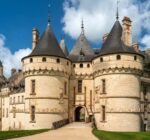

Stand in the courtyard at Chambord on a winter morning, when mist rolls across the formal lawns and the pale stone towers seem to float above the hunting park, and you’ll understand why Francis I spent twenty-eight years building a house he never lived in. This is not a castle built for defence—its moat is ornamental, its turrets decorative—but a monument to Renaissance ambition, dropped into the marshy forests of the Loire Valley as if to prove that a French king could rival anything Italy had to offer.
A King’s Vanity Project
Construction began in 1519, the year Leonardo da Vinci died at nearby Clos Lucé. Whether the aging polymath had a hand in Chambord’s design remains one of architecture’s enduring rumours. The château’s famous double-helix staircase—two spirals winding around a hollow core so that people ascending and descending never meet—certainly bears his signature flair for clever mechanics. But no plans survive, and by the time the first stones were laid, Leonardo was too frail to oversee much beyond sketches.
What we know for certain: Francis I wanted a hunting lodge grand enough to host the Holy Roman Emperor. He conscripted 1,800 workers, diverted a river, and poured the treasury of a kingdom into 440 rooms, 282 fireplaces, and 84 staircases. He stayed there fewer than fifty nights.
The Architecture of Excess
Chambord is best understood from the rooftop terrace, where you can walk among a forest of chimneys, lanterns, and sculpted dormers that transform the skyline into something between a chessboard and a fever dream. This is French Renaissance at its most exuberant: classical symmetry below, Gothic fantasy above, all capped with the king’s salamander emblem repeated in stone across the façade.
The interior is less furnished than you might expect. Chambord was never meant to be comfortable—royal courts were itinerant, and furniture travelled with the king. What remains is space itself: vaulted ceilings, echoing halls, and that central staircase spiralling upward beneath a coffered vault carved with Francis’s initials.
After the King
Louis XIV staged Molière premieres here in the 1660s. Stanisław Leszczyński, the exiled king of Poland, lived out his final years in the east wing. During the Second World War, the Louvre’s treasures—including the Mona Lisa—were hidden in Chambord’s cellars. The château has been a barracks, a hospital, and a symbol appropriated by governments of every stripe. Today it belongs to the French state and receives nearly a million visitors a year.
The surrounding estate is worth as much of your time as the building. At 5,440 hectares, it’s the largest enclosed park in Europe, home to red deer, wild boar, and a network of forest trails that feel a world away from the crowds inside.
If You Want to Visit
Chambord is 180 kilometres south of Paris and an easy day trip by car or train to Blois, then a short taxi ride. The château is open year-round except for 1 January and 25 December. Summer brings the crowds; autumn brings the stag rut in the park, and winter brings that mist. Book tickets in advance online to skip the queue.
If you’re planning a Loire Valley itinerary with several châteaux, consider guided day trips that pair Chambord with nearby estates—Classic Prague Castle Tour, Strahov Monastery & Castle District and similar multi-site packages often include transport and context you’d miss on your own.
Want more stories from France’s château country? Subscribe to Love Castles and get a new destination, legend, or deep-dive delivered to your inbox every week—from the Loire to the Rhine, and every turreted rooftop in between.