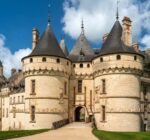


The first thing you notice approaching Bojnice Castle isn’t the white limestone walls or the riot of turrets — it’s the travertine cave yawning beneath the south-eastern foundations, exhaling cool mineral air even in midsummer. Above it, the castle rises in layers: medieval stonework at the base, Gothic arches in the middle storeys, and at the crown a whimsical parade of conical roofs and crenellated parapets that look as though they’ve wandered off the page of a storybook. This is no accident. Bojnice, in its present form, is the product of one man’s obsessive dream to resurrect the romance of the Middle Ages — and the result is one of Central Europe’s most beguiling palaces.

From Medieval Stronghold to Romantic Revival
Bojnice’s recorded history begins in 1113, when it appeared in the written records of the Zobor Abbey as a wooden fortification guarding the trade routes threading through the Nitra Valley. By the 13th century, the Counts of Bojnice had rebuilt it in stone, and for three centuries it passed through the hands of Hungarian nobility, serving as both fortress and administrative seat. In 1528, the powerful Thurzó family acquired the estate and transformed it into a Renaissance residence, complete with an alchemical laboratory and one of Central Europe’s earliest landscaped gardens.
But Bojnice’s current silhouette owes everything to Count János Ferenc Pálffy, who inherited the castle in 1888. Pálffy was an aesthete, collector, and Francophile, and he spent the next two decades remodelling Bojnice in the image of the Loire châteaux he adored — particularly Pierrefonds, which Viollet-le-Duc had recently restored for Napoleon III. Pálffy imported French architects, commissioned frescoes, installed carved wooden ceilings from across Europe, and filled the interiors with Gobelin tapestries, Renaissance altarpieces, and a library of rare manuscripts. When he died in 1908, Bojnice had become a Gesamtkunstwerk: part castle, part museum, part romantic fantasy.

What You’ll See Inside
The interiors unfold as a sequence of cabinet rooms, each styled to a different historical mood. The Golden Hall gleams with neo-Gothic frescoes depicting scenes from Slovak legends and medieval tournaments. The Music Room houses a collection of 18th-century instruments, including a fortepiano once played at court. The Chapel of St. John features an altarpiece attributed to the workshop of Nardo di Cione, a 14th-century Florentine master, testament to Pálffy’s acquisitive eye and deep pockets.
But the real surprise lies below. Beneath the castle, the travertine cave — used variously as a dungeon, wine cellar, and secret escape route — now forms part of the guided tour. The chambers are lit theatrically, highlighting the mineral formations and the well shaft that once provided the garrison with water during sieges. Archaeologists have found evidence of habitation here stretching back to the Neolithic, making Bojnice not just a castle but a palimpsest of human occupation spanning six millennia.

Beyond the Castle Walls
Bojnice sits in the centre of a small spa town of the same name, surrounded by thermal springs that have drawn bathers since Roman times. The castle grounds include a zoo — one of Slovakia’s oldest, established in 1955 — and a sprawling English-style park dotted with lime trees, some planted during Pálffy’s renovation. In late April and early May, the town hosts the International Festival of Ghosts and Spirits, a weekend of costumed theatre, medieval markets, and fireworks that draws tens of thousands of visitors and transforms Bojnice into a stage set.
For those interested in Central European castles shaped by 19th-century romantic historicism, Bojnice offers an instructive counterpoint to the more famous Pena Palace in Sintra, which similarly blends medieval revival with eclectic collecting. Both castles reveal how the past was reimagined — and sometimes invented — by wealthy patrons seeking to anchor national identity in an idealised Middle Ages.
Planning Your Visit
Bojnice Castle is open year-round, though hours vary seasonally. Standard guided tours last approximately 50 minutes and cover the main halls, chapel, and cave; an extended tour adds the tower and armoury. Tickets must be purchased on-site or via the official website, and English-language tours are available with advance booking. The castle is a 2.5-hour drive from Bratislava or a 20-minute train ride from Prievidza, the nearest regional hub. If you’re planning a wider exploration of Slovakia’s castle landscape, consider pairing Bojnice with castles that share its blend of fortress and fantasy .
Bojnice rewards the curious traveller willing to venture beyond the well-trodden routes of Western Europe. It’s a castle that wears its romanticism openly, unashamedly, and all the more enchantingly for it.
Love stories like this? Subscribe to Love Castles for a new castle portrait, hidden gem, or history deep-dive delivered to your inbox every day.
Further reading
- Bojnice Castle Official Website — visitor information, tour bookings, and event calendar
- UNESCO Tentative List: Bojnice Castle — nomination dossier and heritage assessment
- Slovak Tourism Board: Bojnice Castle — history, travel tips, and regional context