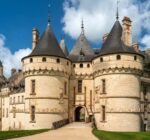


Stand at the confluence of the Eresma and Clamores rivers, look up toward the western edge of Segovia’s old town, and you’ll see why this castle has been compared to the prow of a great ship. The Alcázar of Segovia thrusts forward from its rocky promontory, its pale stone walls rising sheer from the gorge, its conical slate towers—added centuries after the original fortress—piercing the high Castilian sky. In certain lights, especially at dusk when the setting sun washes the limestone gold, the entire structure seems poised to launch itself over the plains below.

A Fortress Layered by Centuries
The site has been fortified since at least Roman times, but the castle you see today is primarily a product of the medieval Kingdom of Castile. The Moors likely built the first substantial fortress here in the early medieval period; after Alfonso VI recaptured Segovia in 1085, Christian kings rebuilt and expanded the Alcázar over successive generations. By the twelfth and thirteenth centuries it had become a favoured royal residence, its strategic position commanding the approach from the north and its thick walls offering security in an era of near-constant frontier warfare.
The Hall of the Kings, with its frieze of 52 seated monarchs carved and painted around the cornice, gives a visceral sense of that continuity—every ruler of Asturias, León, and Castile up to the early sixteenth century gazes down from the walls. It’s propaganda, of course, a genealogical claim to legitimacy carved in wood and plaster, but it’s also a reminder that this castle was never simply a military outpost. It was a theatre of power.

Isabella and the Throne
On 13 December 1474, a young woman rode out from the Alcázar to the Plaza Mayor of Segovia, where she was proclaimed Queen of Castile. Isabella I had been staying in the fortress when news arrived of her half-brother Enrique IV’s death. Her claim was contested—rival factions backed her niece, Juana—but Isabella moved decisively, and Segovia’s Alcázar became the symbolic starting point of her reign. Within a decade, she and her husband Ferdinand of Aragon would complete the Reconquista, fund Columbus, and lay the foundations of the Spanish Empire.
The castle’s Chapel of San Andrés, tucked into the northern wall, still holds traces of that moment: the royal coats of arms, the Gothic vaulting, the sense of a building where devotion and ambition were intertwined. Isabella’s Segovia was a working capital, not a museum, and the Alcázar was at its heart.
For readers interested in other royal residences tied to transformative moments, our earlier piece on Pena Palace explores how nineteenth-century monarchs reimagined medieval forms, while Conwy Castle shows how Edward I used fortress architecture to project power across a contested landscape.

Fire, Restoration, and the Fairy-Tale Silhouette
The Alcázar’s iconic conical towers—the feature that makes it instantly recognisable and reportedly influenced Walt Disney’s design for Cinderella’s castle—are not medieval at all. In 1862, a catastrophic fire gutted much of the interior while the building was serving as the Royal Artillery College. The restoration, completed over the following two decades, took considerable liberties. Architect Francisco de Cubas looked to engravings, romantic imagination, and contemporary Central European castles for inspiration, giving Segovia the slate-roofed, witch’s-hat spires that now define its profile.
Purists sometimes lament the nineteenth-century interventions, but the result is undeniably compelling—a castle that layers Moorish geometry, Gothic drama, and Romantic fantasy into a single, coherent vision. Walk through the armoury today and you’ll find medieval weaponry displayed in rooms with ceilings rebuilt in the 1880s. It’s a palimpsest, and that’s part of the appeal.

If You Want to Visit
The Alcázar is open year-round, and Segovia itself—less than 90 minutes by high-speed train from Madrid—makes an ideal day trip or overnight stop. Buy your ticket in advance online during peak summer months; the castle’s compact interior can feel crowded by mid-morning. Don’t skip the climb up the Torre de Juan II, the keep that predates the fire: 152 narrow steps reward you with a panorama across the sierra and the tile rooftops of the old town, with the Roman aqueduct stitching the view together in the distance.
The castle is a short walk uphill from the Plaza Mayor, and the approach—through the warren of medieval streets—is half the pleasure. If you have time, the adjacent Iglesia de la Vera Cruz, a twelve-sided Templar church just outside the walls, offers a quieter counterpoint to the Alcázar’s grandeur.
Segovia rewards slow exploration: the aqueduct at dawn, the Alcázar at mid-afternoon when the light rakes across the Eresma valley, and a late lunch of cochinillo in one of the timber-beamed restaurants near the plaza. The city feels manageable, human-scaled, but every corner reveals another layer—Romanesque apses, Jewish Quarter lanes, the shadow of mountains to the north.
Love stories of castles where history turned on a single moment? Subscribe to Love Castles and get a weekly dispatch of fortress profiles, hidden gems, and the people who shaped them—delivered every Monday morning.
Further reading
- Alcázar de Segovia official website — visitor information, opening hours, and historical background
- Spain Tourism: Segovia — UNESCO World Heritage context and city overview
- UNESCO: Old Town of Segovia and its Aqueduct — World Heritage listing and conservation details